2013
Iceland, Finland, Estonia, Russia, Mongolia, China, Thailand, Cambodia and South Korea

2014
Germany, Poland, Austria, Hungary, Czech Republic, Romania, Bulgaria, Turkey, Israel, Jordan and Denmark

2015
Hawaii, Australia, Indonesia, Singapore, Vietnam, Laos, Myanmar, Malaysia, Nepal, India and England

2016
Latvia, Lithuania, Ukraine, Slovenia, Serbia, Bosnia & Herzegovina, Croatia, Montenegro, Kosovo, Macedonia, Albania, Greece, Egypt, Bahrain, Qatar, Oman, Ethiopia, Kenya, Zimbabwe, South Africa, U.A.E. and Denmark.

2017
Panama, Colombia, Ecuador (inc. Galapagos), Peru, Bolivia, Chile (inc. Easter Island), Argentina, Uruguay, Brazil and Mexico.

2019

Tuesday, June 18

12/15: Porto's Port & Port Wines 101!

Close to three months ago now I returned from being away on vacation with a friend in New Zealand and Australia for 3.5 weeks. In case you also want to follow that really fun trip Down Under, here's a link to the newest blog:
www.bergersadventures7.blogspot.com

Earlier in the day Steven and I had an interesting time touring the Stock Exchange Palace and two fascinating churches here in Porto. Even though the weather had taken a turn for the worse, we nonetheless decided to take our chances and walk along the riverfront with the eventual goal of stopping at a port wine lodge, something that the city is so famous for.


In the distance was the Dom Luis I Bridge over the 500-foot wide Douro River which was built by a protege of Gustave Eiffel who himself built another bridge a bit upstream. The bridge, inaugurated in October of 1886, was built of two metal trays supported by a great iron arch and five piers.


Before tourism helped make Porto and the rest of Portugal one of Europe's must-see destinations, the Ribeira or riverfront was a working port. The city wall fortified Porto from the river and, until an embankment was built in the 20th century, the water came right up the arches which also served as loading zones for merchants. Nowadays, I read, the old arcades are jammed in better weather with hole-in-the-wall restaurants and souvenir shops. 


The view, such as it was, was to the town of Vila Nova de Gaia or just Gaia across the river where most of the world's port wine comes to mature. I knew not a thing about port wines before coming to Porto except for always reading books where normally British men would retire after dinner to the library to indulge in a glass of port! Port wine grapes are grown and a young port is produced about 60 miles upstream in the Douro Valley. Then, after sitting for the winter in silos for the winter, the wine is shipped downstream to Gaia to age for years in lodges on the cool, north-facing riverbank. 


These distinctive boats, called rabelos, were once the only way to transport wine from the Douro Valley vineyards to the cellars of Porto. The boats had flat bottoms, a big square sail and a very large rudder to help them navigate the rough and twisty river. 


Mid December, we knew after being in Porto for just a few days, was not the most opportune time to visit the lovely city and soak up its many charms! If you've been lucky enough to go to Paris, this wrought-iron bridge might remind you of the Eiffel Tower as it did us.


Immediately across the river was Sandeman, the most high-profile port company and considered the Budweiser of port. They were the first port producer to create a logo and had the "most corporate, mainstream, accessible experience" for people new to discovering the world of port wines. If our apartment owners had not already  given us complementary passes to Churchill's, a port wine lodge located a good walk away, we may have stopped here especially since the weather didn't look like it might improve for a good while. 


Even if there weren't many people out, Steven would have been easy to spot in his bright red umbrella!


Did you know, unlike me, that port was actually a British phenomenon? Because Britain wasn't suitable for growing grapes, wine was traditionally imported from France until the 17th and 18th century wars when Britain boycotted French wines. Portuguese wines generally didn't survive the longer sea journey to Britain. I read the port-making process may have come about accidentally when two Portuguese brothers fortified wine with grape brandy to maintain its quality during the long trip. When the wine picked up the flavor of the oak barrels it was stored in, the British really liked it! Because the British perfected port production in the succeeding generations, many ports have British-sounding names like Taylor, Croft, Graham and, of course, Churchill's.


In 1703, the Methuen Treaty reduced taxation on Portuguese wines which made port even more popular. In 1756, Portugal's Marques de Pombal demarcated the Douro region which meant from that point on that true 'port wine' could only come from this region following specific rules of production just as 'Champagne' technically refers to a specific region in France. 


If the weather were better and not so late in the day, it would have been interesting to spend some time in Gaia.


From the riverfront we walked uphill along deserted streets past centuries' old stone buildings toward Churchill's for our reserved appointment.


How wonderful to warm up and dry up on entering the lodge's  tasting room. Because of the inclement weather, there were only a few others sampling the ports. 


Our personal guide, Joao, told us that Churchill's was started in 1981 by John Graham who left his family's famous Graham port wine lodge to start his own firm. Five hundred million bottles of wine are produced yearly in the Douro Valley with half being port and the rest table wines. 


The area where Churchill's grapes are grown has direct sunlight in the morning which means less acidity which in turn prevents excessive humidity from less wind. It's a natural process with little chance of irrigation and only if prior permission is received from the Port Wine Institute that strictly regulates every facet  of port production. The five week harvest normally takes place beginning in late September. 


Joao mentioned there's little intervention in wine production so harvest is done by hand. That way, there is more juice and the seeds aren't destroyed. When I found out the exclusively local Douro Valley workers stomp on the grapes for six hours a day for five weeks, it sure didn't look as fun as it appeared initially!


Churchill's stops fermentation of their port wine at 75 percent by adding a flavorless fire water like a brandy or white spirit to achieve the perfect taste. After fermentation takes place, filtration occurs in stainless steel vats which have a capacity of 50,000 liters. 


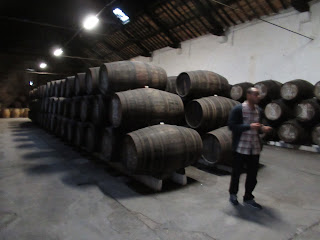
As we walked a short distance to a massive building where the port was ageing in French oak barrels, Joao said that 80 percent of the land in Portugal is used to produce wine!


For most port drinkers, "port" means a tawny port. But I learned that since there were more than forty varieties of grapes used in its production, there's a wide spectrum of port. Leathery-colored tawny port is aged in smaller barrels which maximizes its exposure to wood, and gives it a nuttier flavor. Tawny port remains in the wood from anywhere from ten to forty years. To enhance the complexity of its flavor, all tawny ports are actually a blend of several vintages so that a 30-year old tawny has components that are just ten or twenty years old. Inexpensive Ruby port, by contrast, only ages in the oak vats for three years before being bottled. 


Ruby colored vintage port is the most expensive and comes from a single harvest only. Only wine from the very best vintages is selected, typically two or three a decade. It then must be tested by the authorities; if approved, it's then bottled and aged for another 10-30 years. If not, the wine stays in the casks longer to become LBV or Late Bottle Vintage port. That was invented after WW II when British wine lovers couldn't afford vintage port. LBV is a blend of wines from a single year which age together in huge wooden vats for four to six years. The size of the vats means less exposure to wood which makes it age more quickly. According to the information on the barrel, this LBV was started in 2015 and needs one more year before it will be bottled. The chalk marks on the bottom indicated it was last tasted about a month before we were there, on November 26th, 2018.


All the wine here, Joao stated, are in contact with the old oak barrels used to age port. They are then sold to Scotland so the barrels can be used to age whiskey which was news to me. When Steven and I  visit a distillery in Scotland in late September, it'll be fun to remember that fact!


Each barrel holds an average of 600 liters of which about two percent evaporates. That's called the angels' share!


The marking on the cask indicated the wine was 30 years old and had been last tasted in May of 2018. When this port is released for sale, it will sell for 120 euros a bottle - not cheap stuff!


We also saw white ports which are "young and robust" and aged in barrels for ten years. Joao indicated they were best served chilled with codfish - beloved by all Portuguese - sushi and appetizers.


We came at last to the vintage bottled wines. Joao said it's critical for those bottles to lie down to come into contact with the cork so the wine doesn't become vinegary. To drink a vintage port, the bottle must stand up for 90 minutes because of the sediment and then be filtered or decanted. The bottle is then best drunk within six days. The 2011 vintage was considered one of the best years because of the normal winter and best overall climate with only rain twice at the end of August. Some people bought it then as an investment, paying 60-95 euros a bottle, knowing it would increase in value later. 


Joao was justifiably proud of the fact that Churchill's won its first Gold Medal in 1985, just four years after it opened!


Eighty percent of port wines (or Churchill's, I wasn't sure) are exported, most to the UK and English-speaking countries like South Africa and Canada. No mention of the US was made and I neglected to ask. Churchill's (and other port producers, possibly) are trying to get into Northern Europe like Denmark and Switzerland because they're non-wine producers. It's tough to get into the other European countries, according to Joao, because the people aren't used to drinking port wines. The only distributor in the US is Frederick Wildman & Sons in NY.


The impressive Wall of Fame indicated the many awards Churchill's has won over the years.


After the informative tour, we were led to the fun part of the experience with a return visit to the tasting room! There we were treated to a selection of cheese and crackers and our own server who then plied us with a variety of ports and all for free - we hadn't ever been treated like that when visiting wineries in Napa or elsewhere! The first was 'white' port but it wasn't that white as you can see. It was hard not to smile after the fun tour and coming in out of the chilly wet weather.


The next was a ruby port which had only aged for a maximum of six years in wood barrels. As no year was listed on the bottle, we knew it was a blend of different types of grapes and may have been a blend, too, of different years. 


The ruby port is like a traditional post-dinner port wine that pairs nicely with cheese, chocolate or fruit, according to our server. I much preferred the ruby to the white port as I found the former a little rough. My apologies, Will, for my inexact wine verbiage! We were served a few more but I can't remember those ones at all. What an enjoyable experience that was - I would definitely order a glass of port in the future, something I'd never think of doing prior to being exposed to port wines at Churchill's.


How much prettier once the rain abated Porto looked  from the Gaia side of the Douro! The line of rabelos boats, used until the 1970s for transporting port wine to Porto, were now mostly used for tourists' cruises up and down the river. It took three days to complete the 50-100 mile journey and a crew of four to load just eight barrels onto the the 20-foot boats! 


For the downstream trip, the captain stood on a platform to look out for rocks and shallows ahead, using the long rudder to guide the flat-bottomed boat through whitewater and hairpin turns. It was dangerous work and the river was once lined with shrines where superstitious sailors prayed. 


On arrival in Gaia, the cargo was unloaded and the boat headed back. For the slow trip upstream, the tall square sail helped them ride the prevailing westerly winds. Otherwise, they were pulled by ropes up the worst stretches by men or by oxen on paths that once lined the riverbank. 


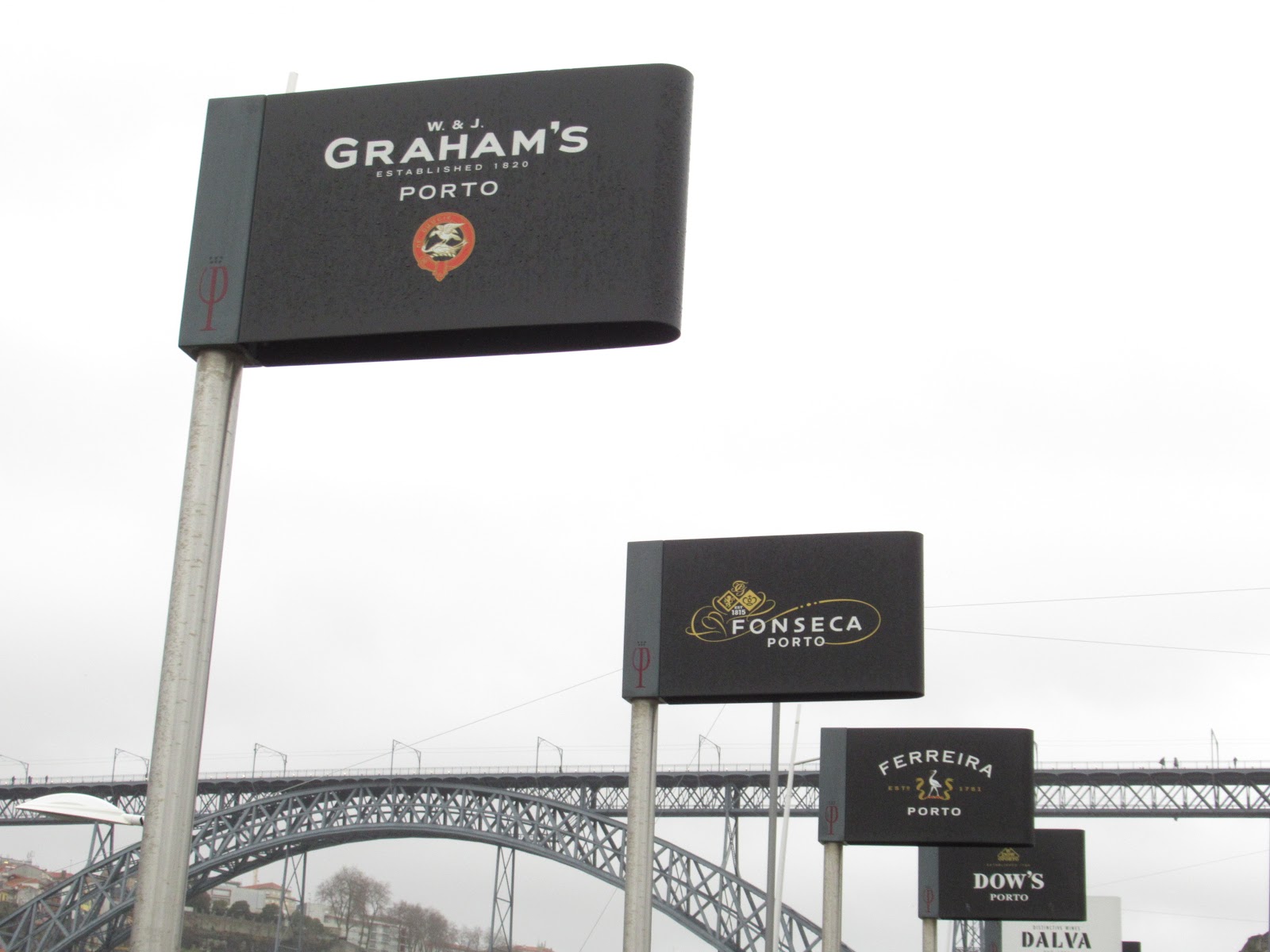
It was great advertising as well as very striking seeing all the signs promoting the port wine lodges along the riverfront. I took special note of Graham's as it was one of the original companies as well where Churchill's owner had his start.


Next post: Sadly, our last day in Porto and Portugal but fun nonetheless exploring more of the enticing city.

Posted on June 18th, 2019, also on our last day at Florida's Grayton Beach State Park but we hope to return in late August of 2020, God willing. 

Friday, June 14

12/15: Porto: Two Lovely Churches & Palatial Stock Exchange!

Over two months ago I returned from being away on vacation with a friend in New Zealand and Australia for 3.5 weeks. In case you also want to follow that really fun trip Down Under, here's a link to the newest blog: www.bergersadventures7.blogspot.com

Just down the traffic-free street from our apartment in central Porto was the elaborate, skinny facade of Misericordia Church. It was also a Chapter House which meant it was a residence for priests and monks. The church was built in the second half of the 16th century but underwent many changes 200 years later because of work done by famed Italian architect Nicolau Nasoni who made his mark in Porto.


I paid special attention to the 18th century St. Anne and the Virgin made from ivory, silver, wood and gold filigree!


Through an 'eyepiece', we caught a great view of the Porto Cathedral that was constructed after the Misericordia Church. 


As part of its Works of Mercy, Misericordia managed hospitals for over 500 years and had an important role providing health services in northern Portugal. The involvement of the church in health care, medical education and humanitarian and social programs was, and still is, critical.


Among the church priorities were taking care of poor prisoners who had no means to defend themselves and no resources for treatment if they ended up in the prison wards. The Misericordia provided them with food and legal support, hiring lawyers to defend them and doctors and surgeons to administer to their health. The Commitment of 1594 ordered that two men responsible for the jails were elected to reflect their humanitarian role.


The church and its foundation established educational institutions, provided assistance and shelter.


When the Blind Asylum of St. Manuel was founded in 1899, it donated the benefactor's assets to the Misericordia on the condition it found a small and modest asylum to accommodate fifteen poor blind men and women and provided vocational training for blind adults. 


The act of giving by benefactors was a deeply religious act which aimed to reaffirm faith. By saving the souls of others, the benefactor was also saving his or her own. The act of giving expressed compassion for those in need which ensured eternal redemption. After the death of the benefactors, arrangements were made to make portraits to perpetuate their memory. Misericordia assembled a vast collection of them from 1649 to 1949 with most being of males. Cynically, I wondered if the size of the paintings was related to the amount of money given by the benefactors to Misericordia!


Of course, I found out that was indeed the case a few moments later when I read the whole body portraits were reserved for royal figures and of benefactors with the most significant legacies!


The history of Misericordia was best seen in its collection of paintings and sculptures, most of which dated from the 16th to the 18th centuries. They were mostly of a religious nature and particularly the prayer for the dead as that was relevant in the everyday practice at Misericordia. 

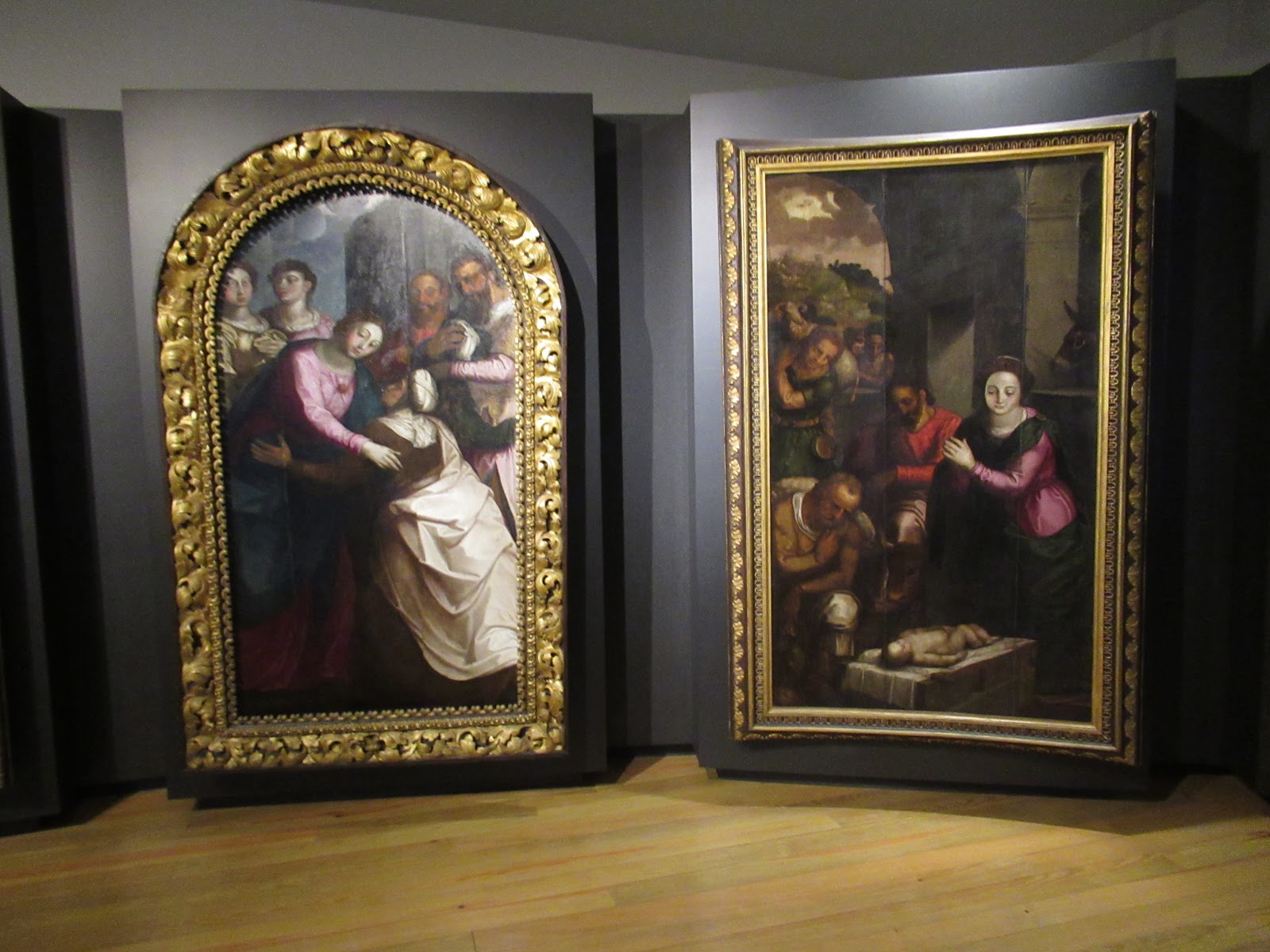
Our Lady of Mercy, also called the Mantle Virgin, was depicted with a large group of people representative of various social strata and characters under her cloak. 


The Holy Family painting documented the overlap between the sacred and daily lives that was characteristic of Flemish paintings of the era.


The information explained the Indo-Portuguese Our Lady of Conception sculpture likely originated in India's Malabar coast given the affinity with the style followed by the artisans of the region.


How apropos that, after seeing the St. Anne sculpture earlier, there was the Flemish Holy Bishop St. Stephen!


I think I could have done without seeing the 17th century Reliquary Head of St. John made from painted wood!


The late 18th century silver Basin for Washing the Feet was used by priests.


The Font of Life was possibly the central panel of an altarpiece whose side panels were lost. The Portuguese coat of arms included the cross of Christ and the five wounds.


I think this was only the second time where we were encouraged to walk behind the painting and therefore notice that x-rays had been taken showing earlier versions of the painting. That was very impressive!


From the pretty amazing exhibits, we finally entered the choir and out first views of the actual church itself. 


Look at all the stunning tile work on all the walls - I just wished we could have walked into the church and seen the tiles up close as they were so marvelous. 


The Misericordia church Side Door was the first phase of work on the church prior to its consecration in 1559.


The Sacristy was built in 1667 and replaced an earlier one. On the walls were preserved tiles and chests made in chestnut wood and jacaranda. 


As we'd seen at one other church, the Main Altar here, too, looked like a wedding cake that had many tiers.


It would have been so very easy to walk right by the unassuming Misericordia Church without having a clue as to what treasures it contained and its strong charitable tradition. I was so glad we did give it a second glance and decided to enter as it was a real find in our opinion.


A couple of blocks away was the big red Borges Market that normally would have excited us but the market had been transformed into a popular nightclub. We beetled past it as we were in a hurry to get to the Palacio da Bolsa or Stock Exchange Palace in order to pick up mandatory tickets for the next English language tour.


The palace actually was neither a stock exchange nor a palace but was considered a monument to civic and commercial pride with some of the most lavishly decorated rooms in the country. It was built by the Commercial Association of Porto in 1832 when the monastery of St. Francisco Church next door burned down and the queen offered the property to the Association. 


Once we found out there wasn't going to be a tour for a while, we figured we might as well spend the intervening time exploring nearby sights then rather than later. The exchange overlooked the large and impressive Henry the Navigator Square named after the famous Portuguese explorer and most important Portuguese person.


The monument in the center of the square was inaugurated in 1900 to commemorate the 5th century of the birth of Prince Henry, the main figure of the Portuguese Discoveries that I referenced in the posts I wrote while in Lisbon. The statue depicted the navigator, who was born in Porto, in battle dress beside a globe and symbolically pointing overseas. 


Just to the left of the Stock Exchange Palace was the apse of the St. Francisco Church, Porto's only church on the Gothic style. The church was Porto's first neo-classical church.


A visit was divided into two parts: catacombs and the elegantly decorated church itself. 


The Dispatch House of St. Francis' Third Order was built in the mid 18th century and designed by Nasoni as was some of the carving used to decorate the interior. 


A view from the top of the church steps to the Douro River: 


The basement housed the Brothers' graveyard. 


We saw numbers on the floor which we thought meant there were other crypts underneath our feet. 


If you're a little bit squeamish, you might want to skip the next couple of photos.


It was far more uplifting seeing the lovely church interior, let me tell you!


The Order's meeting room:


What a sublime view of the church with its magnificent Main Altar!


Another lovely altarpiece represented The Tree of Life and a literal interpretation of the life of Jesus. The twelve figures stood while supporting themselves in the branches of a tree. At the top was a sculpture of the Virgin and Child.


I found the intricate woodwork carved between 1764-1765 in the Our Lady of Solitude just beautiful.


I could hardly envision how any more spectacular the church might have been prior to its being ravaged by Napoleon and by the Portuguese during the country's 19th century civil war as the interior was still so stunning with so many lavish chestnut carvings slathered in gold leaf. 


Franciscans weren't always received as we noticed here when they were depicted being cruelly tortured and crucified by Japanese.


The statue of St. Francis was carved out of a block of granite and rested on a medieval sarcophagus.


Parishioners's bones used to be placed under these boards until people complained of the stench and they were then relocated to the crypt. 


We made our way back to the Stock Exchange Palace for our tour at noon which began in the dramatic Hall of Nations that was decorated with the coats of arms of 20 international trading partners.


I think Portugal's was in the middle flanked by Italy's on the left and Brazil's on the right.


I know you can figure out whom this coat of arms belonged to!


The glorious atrium was topped by a lovely glass dome.


The floor was as pretty as the ceiling with the mosaics inspired by the Pompeii ruins in Italy, no less!


The palatial-looking granite staircase took 40 years to construct.


The 1.5 ton chandelier was sustained by two angels on the top and could be lowered, with the assistance of five people, to the bottom of the stairs twice a year to be cleaned. I wish I could say our chandelier could only be cleaned twice a year because of its weight and size!


A lovely view of the Hall from the second floor:


The gods of culture, industry, etc were represented by women because those words, in Portuguese, were feminine nouns.


The Commercial Courtroom was now only used for wine tastings so it had been much improved from the old courtroom!


One of the paintings was of a public trial in the 16th century that took place in Coimbra, the country's former capital, and where we'd just spent three enchanting days.


The next two works illustrated the main occupation in Porto, i.e. the production and transportation of the port wine the city is known the world over for. 


The furniture was made with French oak, the same wood used for the barrels.


A nearby room had a desk used by Gustav Eiffel of Eiffel Tower fame who spent years in Porto and designed a bridge over the Douro River to Gaia, where many of the port warehouses were located. 


The Golden Room was so named because of its beautiful ceiling. 


The carefully patterned floor was pieced together with exotic Brazilian and African wood from Portugal's colonies. 


The Golden Room opened up to the Presidents' Room which had portraits of former leaders of the Commercial Association. 


Though the stunning room appeared to have wooden details, it turned out only the floor, door and furniture were wood. The rest was actually simply painted plaster to resemble wood as the artist wanted to show he could imitate any material. In addition, plaster was easier to work with and a lot cheaper than exotic woods. 


I would never have guessed this was anything but wood as the plaster looked like a perfect imitation. 


The incredibly detailed inlaid table took three years and lots of patience to create using wood scraps from the fine wood floors.


The finale was the sumptuous Arabian Hall which was inspired by Granada's Alhambra we'd toured a few weeks earlier. Created by Portuguese artisans from 1862-1880, they used mainly exotic woods and 20 kilos of gold leaf! 


The guide told us the official reception room showed the city's economic power. It was used for greeting visiting dignitaries, as a ballroom and had offices on its upper level. It was perfect for concerts because of its amazing acoustics. 


Note the exquisite details on the walls with Arabic script there and on the shields.


The guard remarked offhandedly that the room could be rented for the evening for merely 7,000 euros, and the entire palace for just 50,000 euros for a full day. What a relief our three older children, who had recently married within ten months of each other, hadn't gotten wind of the Bolsa for a destination wedding!


Before reluctantly leaving I was able to snag a picture of Steven admiring the stunning atrium again.


Next post: Walking along the riverfront in pouring rain a little later toward Churchill's, one of the city's port establishments.

Posted from Grayton Beach State Park in Florida on June 14th, 2019, the morning after the Toronto Raptors won the NBA Championship!